

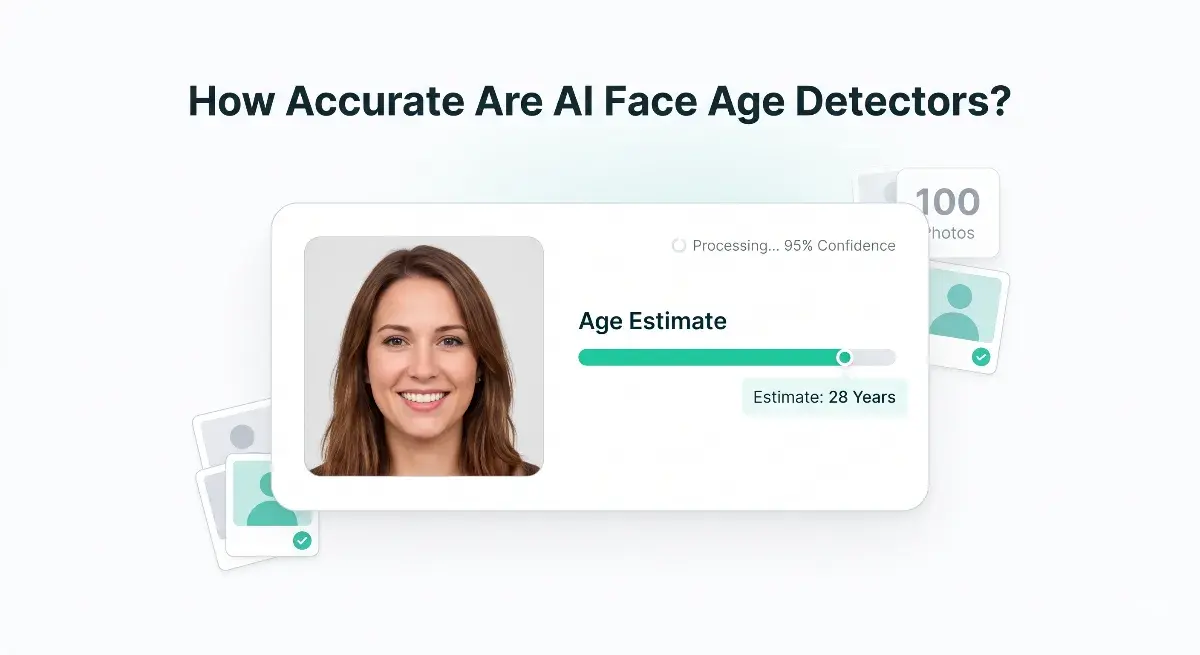
AI age detectors are everywhere now—inside selfie apps, age‑verification systems, and curiosity tools that guess your age from a single photo. Naturally, people ask: how accurate is AI age detection, really?
Instead of pretending we’ve run a giant lab experiment, this article looks at how age‑estimation systems are evaluated, what independent tests and vendors report about accuracy, and what you can realistically expect when you upload a selfie to a tool like FaceAgeMeter.
What Is an AI Face Age Detector?

An AI face age detector is a model that estimates a person’s age from a photo of their face. It doesn’t look at your ID or date of birth—just visual signals like skin texture, facial structure, and the eye area.
These tools are trained on large datasets where each face image is paired with a known age, so the model can learn patterns that tend to show up at different stages of life.
How the technology works
Most modern age‑estimation systems follow a similar pipeline:
Detect the face and align it.
Identify facial landmarks around the eyes, nose, mouth, jawline, and forehead.
Encode the image as a feature vector and pass it to a deep neural network that outputs an age estimate.
Performance is usually summarized with mean absolute error (MAE)—the average number of years between the predicted age and the true age across a test set. Strong commercial systems report MAEs in the range of roughly 1.5 to 5 years, depending on age group and dataset difficulty.
The difference between age detection and age verification
It helps to distinguish two related but different tasks:
Age detection: predicting a numeric age or age range from a face.
Age verification: deciding whether someone is above or below a threshold (for example, 18 or 21) for access to age‑restricted content or purchases.
Age‑verification systems focus on minimizing risky errors (like approving minors as adults) and may work with coarse age bands, while detection tools are tuned to give a reasonably close numeric age for curiosity and analysis.
FaceAgeMeter sits on the detection side: it estimates your apparent age from a selfie, then shows the result with a clear, privacy‑first interface.
How Accuracy Tests for AI Face Age Detectors Work
Even though we’re not claiming a specific in‑house test here, it’s useful to understand how accuracy studies are typically designed for age‑estimation software. Independent groups and vendors follow broadly similar steps.
Test methodology — different ages, genders, ethnicities
A typical evaluation uses a dataset of images where each person’s true age is known. The test set is usually balanced across:
Age ranges (younger adults, middle‑aged, older adults).
Genders.
Different skin tones and ethnic backgrounds, to see how the model behaves across populations.
The algorithm predicts ages for each image, and researchers compute metrics like MAE and “within X years” accuracy (for example, the percentage of faces where the estimate is within 3 years of the real age).
Photos with makeup vs. without makeup
Real‑world tests often include faces with and without makeup, because cosmetics can either hide cues of aging or accentuate them.
Smoothing foundation and filters can reduce visible lines and uneven texture, nudging estimates younger.
Heavy contouring, dark eye makeup, and strong shadows can make features appear more pronounced and sometimes older.
Including both styles in a test gives a more realistic picture of how the system will behave on everyday selfies.
Young vs. elderly faces — who does AI guess best? Studies consistently show that age‑estimation models perform differently across age groups:
Error tends to be lower for younger faces and certain mid‑life ranges.
Accuracy drops for older adults, where aging patterns become more varied and harder to generalize.
Some systems report particularly low MAE for minors (important for age‑verification use cases), while error increases modestly as ages climb.
What Current Data Says About Accuracy
Because FaceAgeMeter is still evolving, it’s more honest to look at public benchmarks and vendor claims rather than invent numbers. Those already tell a useful story about what “accurate” means in this domain.
Typical age error margin (±X years) Public evaluations and vendor documentation report roughly:
Mean absolute errors around 3 years for diverse adult datasets in strong commercial systems.
Better performance—sometimes under 2 years MAE—for narrower age ranges or child‑focused sets.
In plain terms, this means a good face age detector will often land within a few years of your actual age, especially in clean, well‑lit photos, but you should expect occasional larger misses.
Where AI gets it right AI age detection tends to be most reliable when:
The photo is sharp, well lit, and front‑facing.
The person’s appearance follows typical aging patterns (no recent major weight changes, surgeries, or very strong filters).
Expression is neutral or mild, so lines and folds appear as they normally do.
Under these conditions, the network can see the cues it was trained on—wrinkles, texture, skin tone, and facial shape—and match them to age patterns with reasonably tight error.
Where AI struggles (heavy makeup, extreme angles, low lighting) Age‑estimation algorithms are less consistent when input images are far from training conditions:
Heavy makeup and smoothing filters obscure texture and wrinkles, pushing estimates younger than reality.
Extreme angles or profiles distort facial proportions and hide one side of the face, making it harder to read age cues accurately.
Low lighting, blur, or noise hide fine details and introduce misleading shadows, which can add or remove apparent years.
If a tool’s estimate seems far off for you, your photo conditions often explain more of the gap than the algorithm itself.
How Does FaceAgeMeter Fit Into This Landscape?
Given the wide range of accuracy numbers published for different systems, it’s fair to ask where a browser‑based, privacy‑first tool like FaceAgeMeter belongs. Rather than claiming exact figures, we can talk about its design priorities.
What makes a good age detection model Across research and vendor reports, strong age‑estimation models share a few qualities:
Training on large, diverse, well‑labelled datasets, not just narrow or biased samples.
Regular evaluation with clear metrics (MAE, “within X years,” threshold accuracy) on independent test sets.
Monitoring for bias across age groups, genders, and skin tones, and retraining or adjusting when patterns of error emerge.
FaceAgeMeter follows that philosophy: treat accuracy as something to measure and improve over time, not something to over‑promise in a single blog post.
Privacy-first approach — why processing happens in your browser Age estimation often involves sensitive face data, so how the analysis is done matters as much as the number it outputs.
FaceAgeMeter’s interface emphasizes that images are analyzed privately and securely, with processing happening in the browser rather than storing your photos long‑term on a server.
This aligns with privacy‑friendly age‑assurance guidance: minimize data retention, give users transparency about what’s happening, and avoid repurposing face images for unrelated training or marketing.
How to Get the Most Accurate Result
Whatever tool you use, the quality of your selfie has a big impact on how accurate AI age detection can be. The good news is that a few simple tweaks usually help.
Best photo conditions (lighting, angle, expression) If you want your FaceAgeMeter result as close as possible to your real age, aim for:
Even, bright lighting: natural window light or diffused indoor light that doesn’t cast deep shadows under your eyes or nose.
Front‑facing angle: camera roughly at eye level, looking straight ahead, so your features aren’t stretched or compressed.
Minimal filters: no heavy smoothing or color distortion; let your real skin texture show.
These are the same kinds of conditions used in many age‑estimation test datasets, which is why algorithms tend to perform best on that kind of image.
Why neutral expression works best Human studies and AI analyses both show that expression changes perceived age. Smiles and exaggerated expressions can deepen certain folds or smooth others.
A relaxed, neutral expression gives the model a straightforward view of your typical lines, eye area, and facial tone, which usually leads to more stable predictions.
You don’t have to look serious—just avoid extreme posing when you’re genuinely curious about accuracy.
Front-facing vs. side photos Most age‑estimation systems are trained mainly on frontal or near‑frontal images. Side profiles and strong three‑quarter angles hide one eye, change jawline perspective, and alter visible volume in the cheeks.
If you upload a profile shot, treat the age result as more playful than precise. For a realistic estimate, stick with a straight, front‑facing photo that matches typical training data.
FAQ
Why does AI think I'm older than I am?
When AI guesses you older than your real age, it’s usually reacting to visible cues: deeper lines, sun damage, volume loss in the mid‑face, or strong shadows around the eyes and mouth.
Photo choices matter too; harsh overhead lighting, close crops, and high contrast can make skin texture and dark circles look more pronounced, adding perceived years for both humans and algorithms.
If you suspect your lifestyle is fine but your photos are rough, try a neutral, well‑lit selfie near a window and compare the result.
Does photo quality affect accuracy?
Yes. Accuracy depends heavily on image quality.
Blur, noise, or low resolution hide the fine details models rely on, while compression artifacts and strong shadows create misleading patterns that the network might misinterpret.
High‑quality, well‑lit, front‑facing images—even from a phone—tend to produce much tighter age estimates, which is why serious evaluations and age‑verification vendors stress good input conditions.