
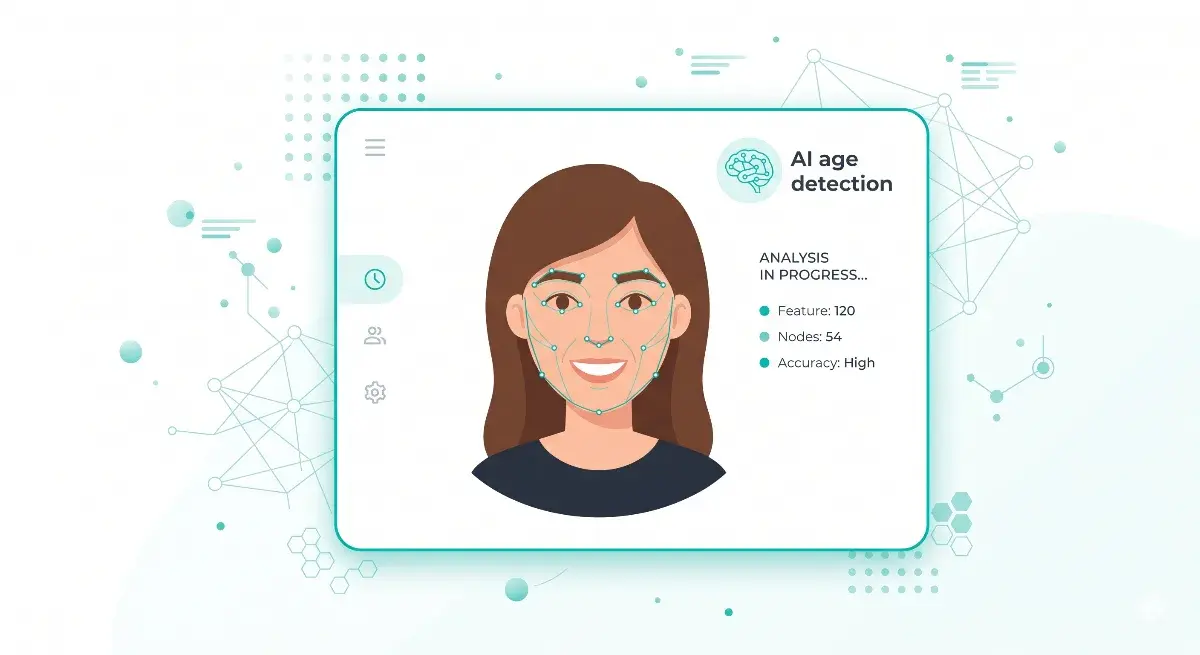
If you’ve ever looked at a selfie and thought, “What does my face say about me?”, you’re not alone. Apps and websites built on face analysis AI now claim they can read your age, gender, and even emotional state directly from a photo—and many of them are free to try.
FaceAgeMeter sits in that world too: upload a clear selfie and our AI estimates your facial age, gender presentation, and basic expression in seconds, all processed privately in your browser.
Beyond Age — What AI Can Read From Your Face
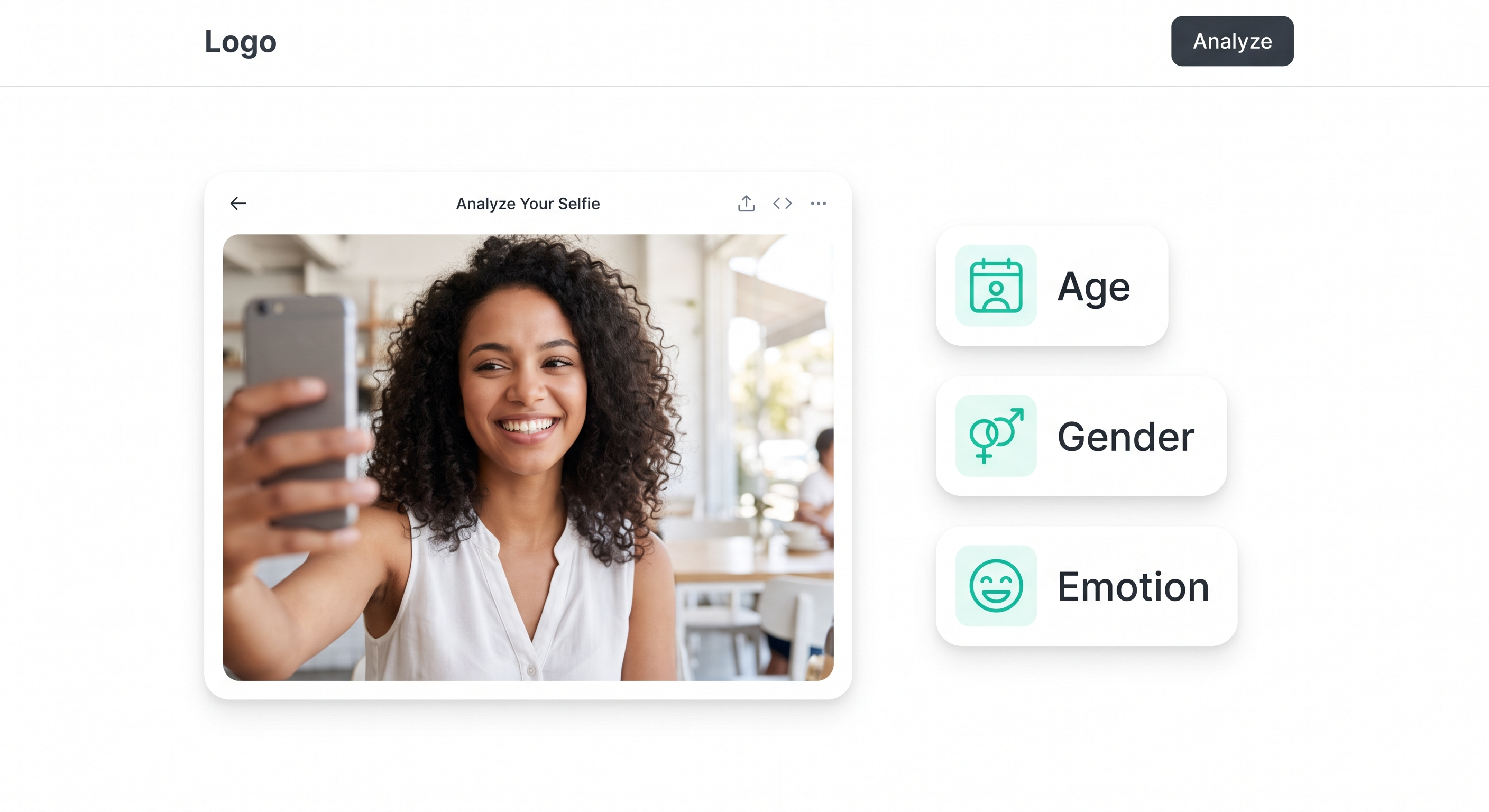
Face analysis AI is really a bundle of different models working together on the same image. The three most common tasks are age estimation, gender detection, and emotion recognition.
Age estimation — how old do you look?
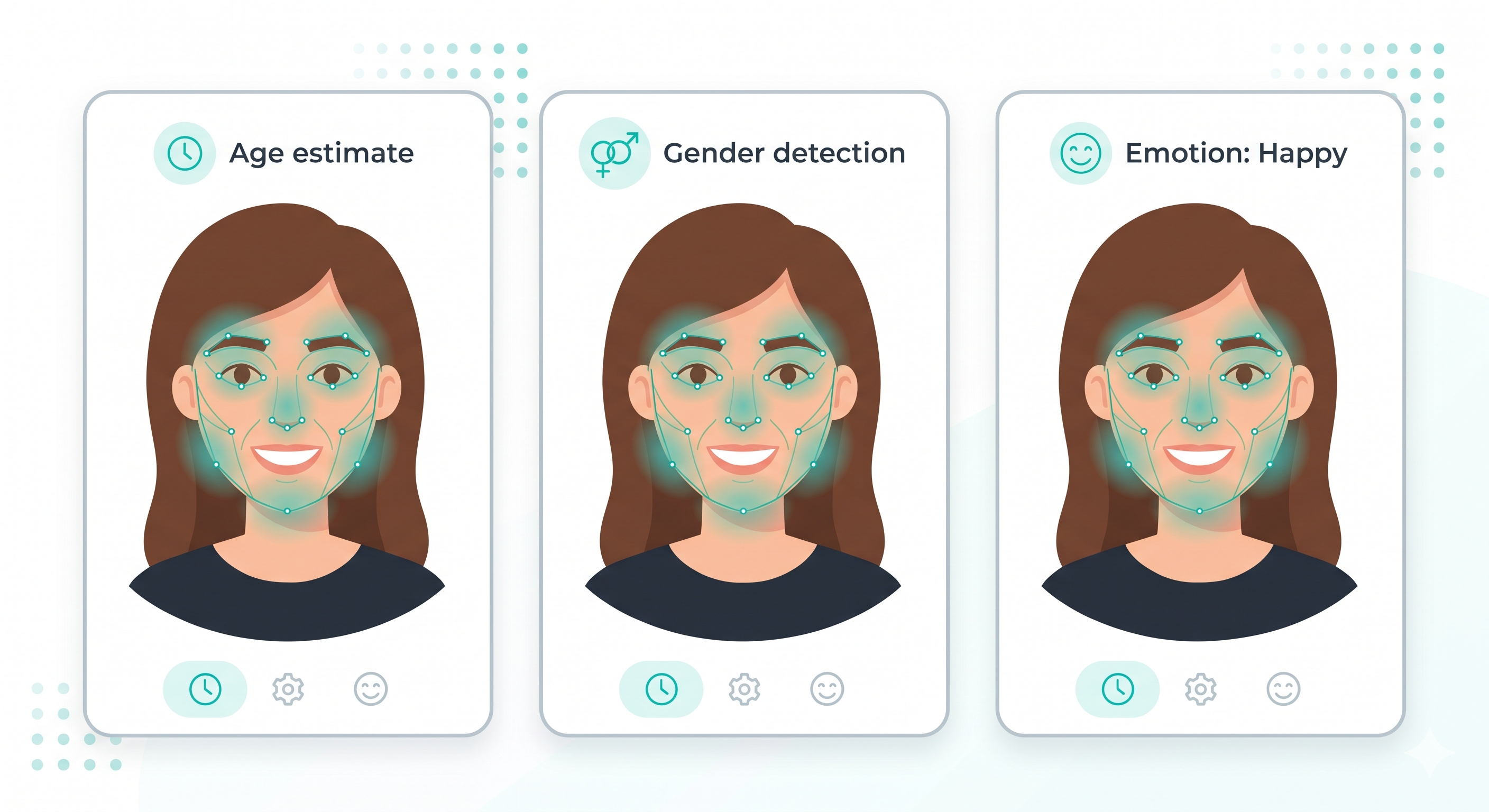
Age estimation models try to answer, “How old does this face appear?” based on patterns learned from large datasets of faces with known ages.
They look at things like skin texture, the depth of lines, volume in the cheeks and jaw, and changes around the eyes and mouth, then output a likely age or age range. Strong systems trained on good data often land within a few years of your real age in clean, well‑lit photos.
On FaceAgeMeter, that estimate shows up as your “face age”—a quick read on how old you look in that particular photo, not a judgment on your actual birth date.
Gender detection — how it works
 Gender detection models don’t know anything about identity labels; they simply learn visual patterns that tend to correlate with male or female presentation in the training data.
They pay attention to features such as brow shape, jawline, facial hair, and overall structure, and output a probability that the face looks more typically male or female under that system.
Tools like FaceAgeMeter use this to show a simple “Gender” result alongside age, but it’s always an appearance‑based guess, not a statement about how you define yourself.
Emotion recognition — can AI tell if you're happy?
Emotion recognition models are trained on datasets of facial expressions labeled with emotions like happiness, sadness, anger, fear, surprise, and neutral.
They track action units—small muscle movements around the eyes, eyebrows, nose, and mouth—and infer which emotion pattern is most likely present in the photo.
In practice, this works best for clear, universal expressions: a big smile is often tagged as “happy,” a furrowed brow and tight mouth as “angry,” while subtle mixed feelings can confuse the model.
FaceAgeMeter sticks to simple labels like “Happy” or “Neutral,” giving you a quick sense of what your face is “broadcasting” at the moment the photo was taken.
The Science Behind Facial Analysis
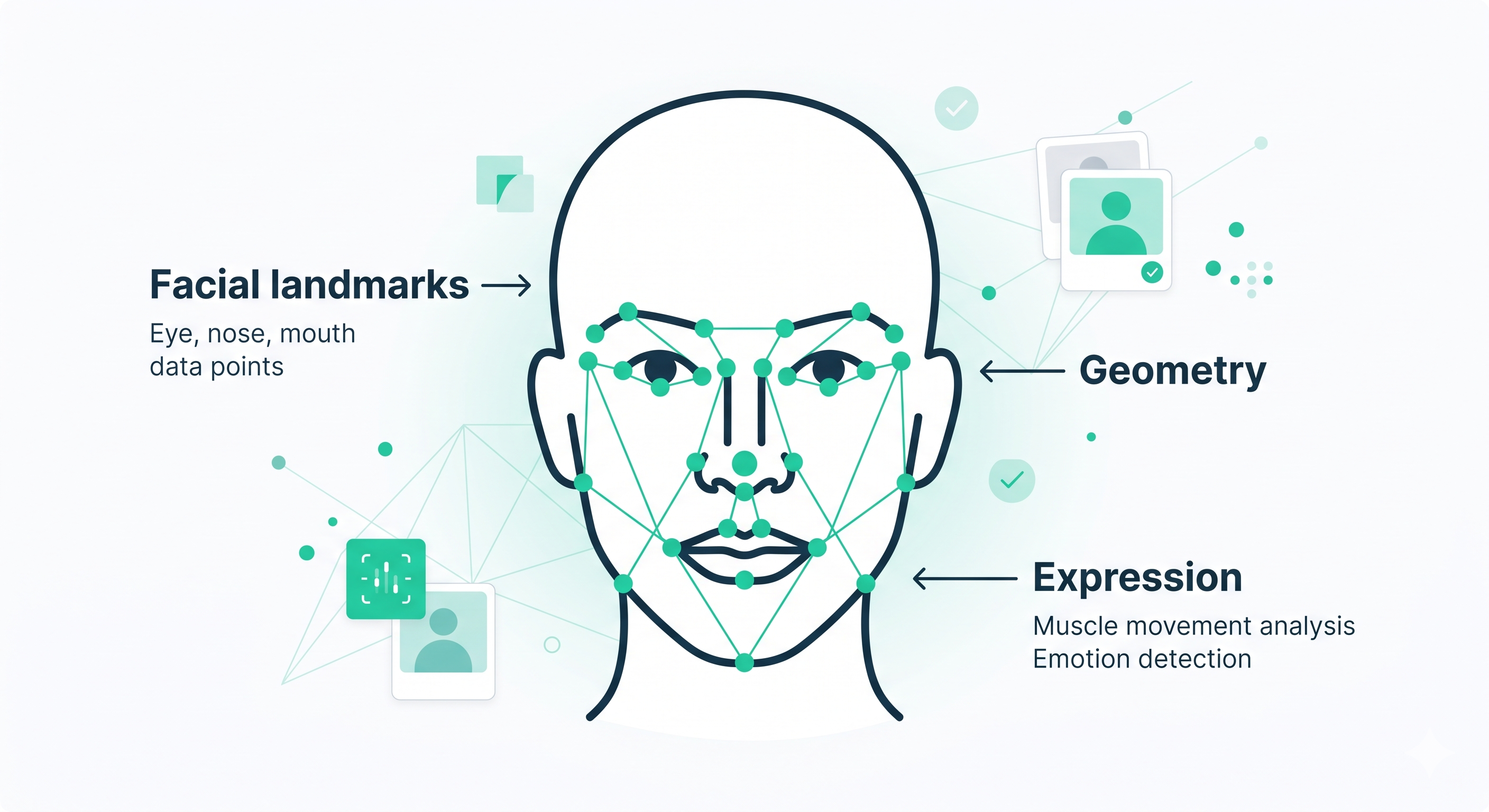
Under the hood, facial analysis is more math than magic. Modern systems rely on facial landmarks, deep learning, and facial geometry to turn a selfie into numbers a network can understand.
What are facial landmarks?
Facial landmarks are key points on the face—corners of the eyes, tip of the nose, edges of the lips, outline of the jaw, and so on.
Algorithms detect and track these points to understand pose, expression, and proportions, which is essential for tasks like age, gender, and emotion estimation.
How deep learning reads faces
Deep learning models, typically convolutional neural networks, take a normalized face image and learn to recognize complex patterns—wrinkle shapes, shading, textures, and the way different features combine.
Over time, these networks become good at mapping from facial features to labels like “looks about 30,” “likely female,” or “happy expression,” as long as they’ve been trained on diverse, high‑quality data.
The role of facial geometry in age prediction
Facial geometry—ratios, angles, and distances between landmarks—also changes with age. Studies show the areas around the eyes, mouth, and mid‑face are particularly significant for age prediction.
Age‑estimation models combine geometry with texture cues to decide whether a face looks more like a teenager, a young adult, or someone later in life.
Fun Ways People Use Face Age Detectors
Most people meet this technology through fun, low‑stakes experiments, not formal research. Face age detectors lend themselves to social, viral use.
Comparing results with friends and family
One popular use: upload photos of friends or family members and see how different faces land. People laugh when a younger sibling gets a higher age estimate, or when a parent’s vacation selfie suddenly looks years younger.
Because these tools respond to lighting, angle, and expression, they can also spark good conversations about how we present ourselves and what photos we choose.
Testing old vs. new photos — have you aged?
Another common experiment is to feed old and new photos into face analysis AI and watch how the predicted age shifts.
Seeing a sequence of estimates over time can make aging feel more concrete—but it also shows how much style, camera quality, and lifestyle can influence perceived age in pictures.
Checking if skincare is working
Some people use repeated age estimates as a rough proxy for skincare progress: they’ll upload similar selfies before and after changing routines and compare whether their “face age” nudges downward.
It’s not a scientific measure, but it can help you notice visible changes in texture, glow, and expression that you might otherwise overlook.
Is Face Analysis AI Safe to Use?
Whenever you upload a face photo, it’s fair to ask what happens to it and whether the analysis is privacy‑friendly and legally compliant—especially under frameworks like GDPR.
What happens to your photo after analysis
Different services handle photos in different ways. Some send images to a server, store them, and reuse them for future model training; others process locally and discard them immediately.
FaceAgeMeter is designed for short‑lived, browser‑based analysis: your photo is processed to extract age, gender, and emotion estimates and then discarded, rather than being kept in a central biometric database.
Why browser-based processing is more private
Privacy‑preserving age and face analysis providers increasingly emphasize on‑device or in‑browser processing, where the model runs locally and no raw face images travel to remote servers.
This reduces risk because fewer systems ever see your data, and there’s no central store of face images that could be misused or breached. It also aligns well with GDPR principles of data minimisation and purpose limitation.
FaceAgeMeter follows that pattern, giving you instant results without keeping a copy of your face, which makes casual, curiosity‑driven use much safer.
GDPR and face data — what you should know
Under GDPR, a face photo is personal data, and if it’s used to create or store biometric templates, it can become “special category” data with extra restrictions.
Key points for everyday users:
Services should clearly explain what happens to your photo.
Storing biometric identifiers or using them for profiling requires a lawful basis and often explicit consent.
Privacy‑first solutions that avoid storage and run on‑device are generally considered lower risk when used responsibly.
If a tool doesn’t explain any of this, it’s reasonable to be cautious before uploading your face.
Try the Free Face Analysis Tool
At FaceAgeMeter, we keep things simple: free AI face analysis focused on age, gender, and expression, with a clean, browser‑based interface.
If you want to know what your face “says” in a selfie, you can try it in under a minute.
Step-by-step guide
Open FaceAgeMeter in your browser.
Choose a clear, front‑facing photo—no heavy filters, no sunglasses or masks.
Upload the image using the drag‑and‑drop box or file picker.
Wait a moment while the AI analyzes your facial features.
View your results: estimated age, gender presentation, and a simple emotion label.
For a deeper dive into the “How old do I look?” side specifically, you can also read our age‑focused guide: “How Old Do I Look? AI Can Now Tell You in Seconds” on the FaceAgeMeter blog.
What your results mean
The numbers and labels you see are appearance estimates based on that photo, not fixed truths. Age is an approximation; gender is based on visual cues; emotion is the expression your face appears to show.
Use them as a mirror with a bit more structure: they can spark interesting questions about how you come across, but they don’t define you.
For a more technical breakdown of accuracy, ranges, and error margins, check our article “How Accurate Are AI Face Age Detectors? What You Should Really Expect”, which explores current research and benchmarks.
Share your results with friends
Once you’ve seen your own result, it’s natural to share. Some people screenshot their FaceAgeMeter output and post it to social or send it in group chats as a fun conversation starter.
If you do, remember to respect other people’s privacy and preferences; not everyone wants their face and perceived age circulating online.
Frequently Asked Questions
Is face analysis AI racist or biased?
Bias is a real concern. Studies show that both humans and AI make more errors when estimating age or recognizing emotions on certain groups, such as older adults, women, and people with darker skin tones, especially when training data isn’t diverse.
Responsible tools work to mitigate this by using broader datasets, monitoring performance across demographics, and being clear that results are estimates, not judgments about worth or character.
Can it work on cartoon or drawing faces?
Most age, gender, and emotion models are trained on real human faces, so they won’t give meaningful results on cartoons, anime, or sketches.
Some systems will refuse to process non‑human images; others might still output something, but those numbers are essentially noise, not reliable analysis.
What's the youngest/oldest age it can detect?
Age‑estimation tools usually work best within a certain range, such as children above a few years old through older adults, and their error tends to grow near the extremes.
Some systems are explicitly tuned for age‑verification thresholds (for example, under vs. over 18), while others aim to predict full numeric ages; their effective range depends on training data and design.